
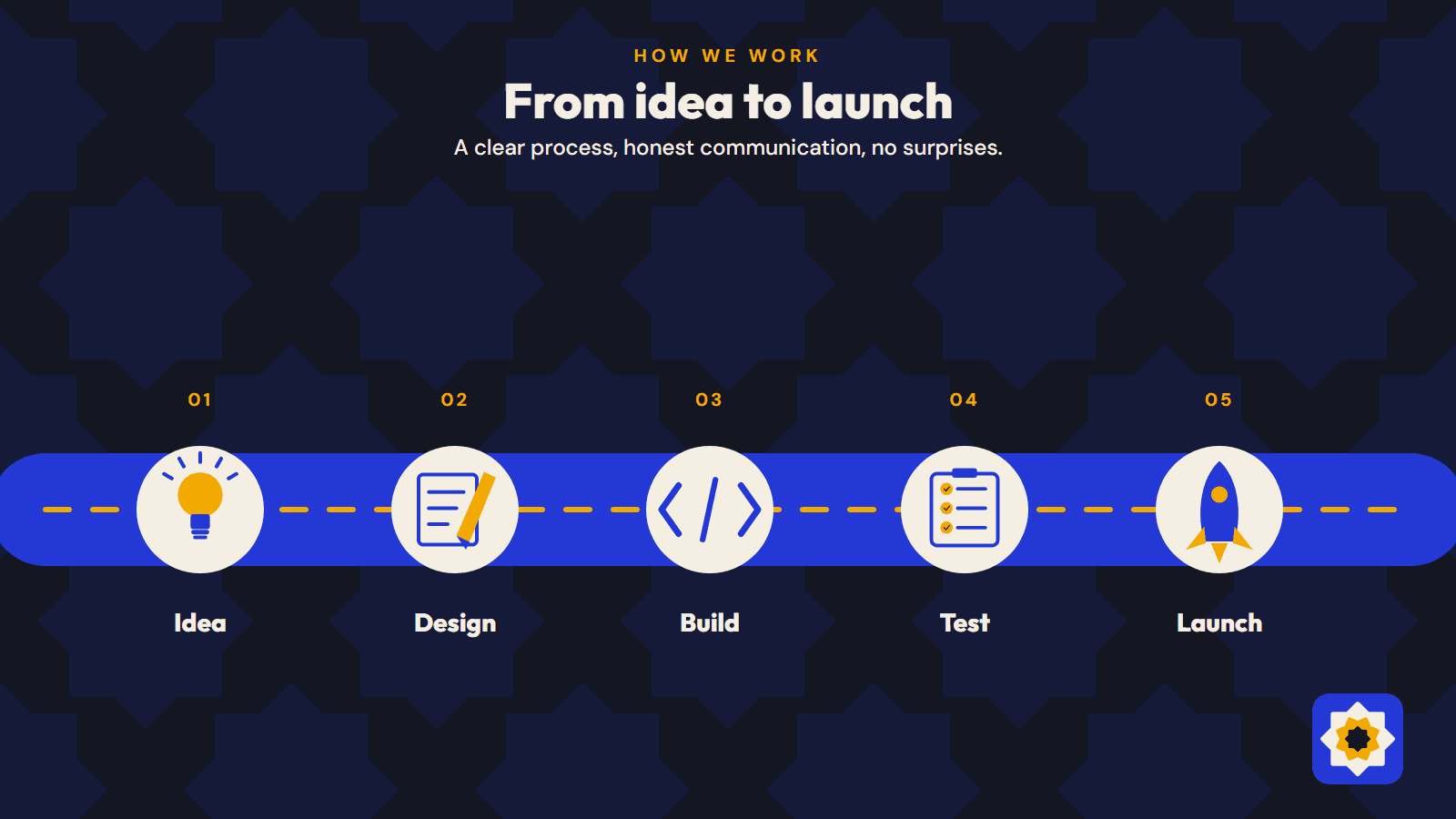
Most clients do not lose sleep over the technology. They lose sleep over the unknown: What happens after we sign? How long will it take? Who writes the content? What if we do not like the design? What happens after launch?
A clear process does not remove every surprise. It makes the important ones happen early, when they are still cheap to fix. Here is how we build a project at Bazzario, from the first conversation to the day after launch.
Phase 1: Discovery, before we talk about price
We start with the business, not the pixels. A discovery workshop covers what the business does, who buys, what those buyers need to decide, what the current site does badly, what success looks like in three, six and twelve months, and the constraints: budget, deadline, content, internal team and must-haves.
We ask for numbers when they exist: leads, orders, average basket, conversion, response time, ad spend. If there are no numbers, we define what we will measure. A project without a success metric becomes a debate about taste.
The output is a short brief, a sitemap, a priority list and a recommendation: website, store, app or custom software. Sometimes the honest recommendation is “do not build this yet” — because the offer, the content or the operation is not ready.

The most useful question
If this project works, what will be different in six months? If the answer is “it will look nicer”, we have not found the real job yet. If the answer is “we will handle twice the orders without hiring”, we have something to design around.
Phase 2: Scope, quote and plan
After discovery, we write a scope that a non-technical person can read: what is included, what is not, who is responsible for what, how many feedback rounds are included, and what happens if the scope changes.
We separate the one-time build from the monthly costs: hosting, domain, maintenance, licences, SMS and email, payment fees and courier integration. A quote that hides the running costs is not a quote; it is a surprise waiting for month two.
We agree on milestones and a payment schedule. A deposit starts the work; later payments are tied to visible milestones, not arbitrary dates. We also name one decision-maker on your side. Projects slow down when feedback comes from five people with five different opinions.
What we need from you during the project:
- A decision-maker: one person who can approve the work.
- Content and facts: services, prices, delivery times, policies and product data.
- Brand assets: logo, fonts, colours, photos and any existing guidelines.
- Access: domain, hosting, analytics, Google Business Profile, social accounts and any current CMS.
- Feedback within two business days: consolidated, specific and in one message.
- A real test order or booking: so we can test the full chain, not only the form.
A fixed price is not a promise that nothing will change. It is a promise that changes will be discussed and priced before they happen.
Phase 3: Design
We design the structure before the decoration: sitemap, user journeys, wireframes. Then the visual layer: typography, colour, components, and the states most sites forget — empty, loading, error and success.
We design mobile-first, at 360 pixels before desktop. Arabic and French are considered from the start, including right-to-left layout, not added at the end. A translation is not a design; the layout has to survive it.
For the key flows, we build a clickable prototype: home to product, product to checkout, contact, booking. You click it before we write production code. It is cheaper to change a prototype than a finished build.
Design is not decoration. It is the order in which the customer understands, trusts and acts.
Feedback works best when it is specific. “I do not like it” is a feeling; “I cannot tell which button is the main action” is something we can fix. We ask what job the page has to do, and we test the design against that job.
Phase 4: Build
We build in a staging environment, not on the live site. You get a private link and regular progress updates. You can see the work as it grows; we do not disappear for two months and return with a surprise.
The build covers the front end (responsive components, performance, accessibility, SEO basics), the back end (CMS, products, orders, users, roles and integrations), and the content (pages, product data, translations and metadata).
We integrate only what the scope needs: payment, delivery, CRM, email, analytics, WhatsApp, booking. Every integration is tested with real data, not only a happy-path click. If something is not working, we say it early. A delay communicated early is a scheduling problem; a delay discovered at launch is a trust problem.
Phase 5: Content, SEO and the boring details
Content is the most common reason projects miss their date. Pages need copy, photos, prices, policies, product data, translations and approvals. We can write, translate or edit; we still need your facts and your approval. AI can draft, but it cannot verify your prices, your delivery times or your legal claims.
SEO is not a plugin. It is structure, page titles, headings, internal links, metadata, image alt text, fast pages and a Google Business Profile. We set the foundation; content and reviews continue after launch.
Legal pages matter too: terms, privacy, delivery and returns, and cookies where needed. For a store, the payment and delivery policies on the site must match what actually happens at checkout and at the door.
Content is not a side quest
If the copy and photos are not ready, the launch date moves. We can help produce them, but we cannot approve your prices or your legal terms for you. The fastest projects are the ones where one person owns the content and answers questions within a day.
Phase 6: Test like a customer, not a developer
We test on real devices: a mid-range Android, an iPhone, a small laptop and a slow connection. We test forms, validation, checkout, payment, emails, WhatsApp links, maps, languages and the 404 page.
We also test the unhappy paths: empty cart, failed payment, wrong phone number, out-of-stock product, refused delivery and expired session. The happy path is the demo; the unhappy paths are the product.
Performance and accessibility are part of the test: compressed images, limited fonts, caching, hosting, contrast, labels, keyboard navigation and touch targets. You do a user acceptance test with a short script: complete the main tasks as a customer would. We fix what blocks the task, not every personal preference.

A launch with no test order is not a launch. It is a hope. For a store, we run a real order through payment, confirmation, dispatch and delivery before the public sees it.
Phase 7: Launch
Launch is a checklist, not a button: domain and DNS, SSL, redirects from the old site, analytics, Search Console, sitemap, robots, backups, email, payment production keys, delivery account, monitoring and uptime alerts.
We launch in a low-traffic window, run a real order or booking, and watch for errors. We keep the old site available until the new one is stable. After launch: training, documentation, handover, a support window, and a review of the first two weeks of data.

The first month is not “done”. It is the first real feedback loop. Real customers will use the site in ways the prototype did not predict; the job is to watch, learn and fix the friction.
How long it takes: estimates, not promises
| Project | Planning estimate | What can move it |
|---|---|---|
| Landing page | 1 – 2 weeks | Copy, photos and feedback speed |
| Business website | 3 – 5 weeks | Pages, languages, content and integrations |
| Online store | 4 – 8 weeks | Products, payment onboarding and delivery setup |
| Custom app or software | 8 – 16+ weeks | Scope, integrations, data migration and testing |
These are planning estimates for a typical project where the content is ready. The proposal fixes the timeline after discovery. If you have an event or a launch date, tell us at the start; we will work backward and tell you what is realistic.
Timelines are not a measure of quality. A fast launch that breaks checkout is slower than a careful one. The goal is not to be early; it is to be ready.
What makes projects late
- Late content: copy, photos, prices and policies arrive after design is approved.
- Moving scope: a new page, feature or language is added without changing the plan.
- Slow feedback: a week per round turns a five-week project into a ten-week project.
- Too many decision-makers: no one can say yes, so everyone says “maybe”.
- Missing access: domain, hosting, analytics or payment accounts are not available when needed.
- Undiscovered data problems: the old site's content or product data is messier than expected.
- Payment or courier onboarding: approval takes longer than the build.
We can recover from most of these if they are visible early. We cannot recover from silence.
Final word
A good process is not bureaucracy. It is how we protect your budget, your launch date and your sanity. The goal is a project where you always know what is happening, what comes next, and what we need from you.
If you are deciding what to build, read Website vs. Mobile App vs. Custom Software. If you are launching a store, read How to Sell Online in Morocco. For budget ranges, see the 2027 price guide.
Have an idea and a rough budget? Book a discovery call. We will tell you what we would build first, what we would delay, and what it should cost. Contact us.