
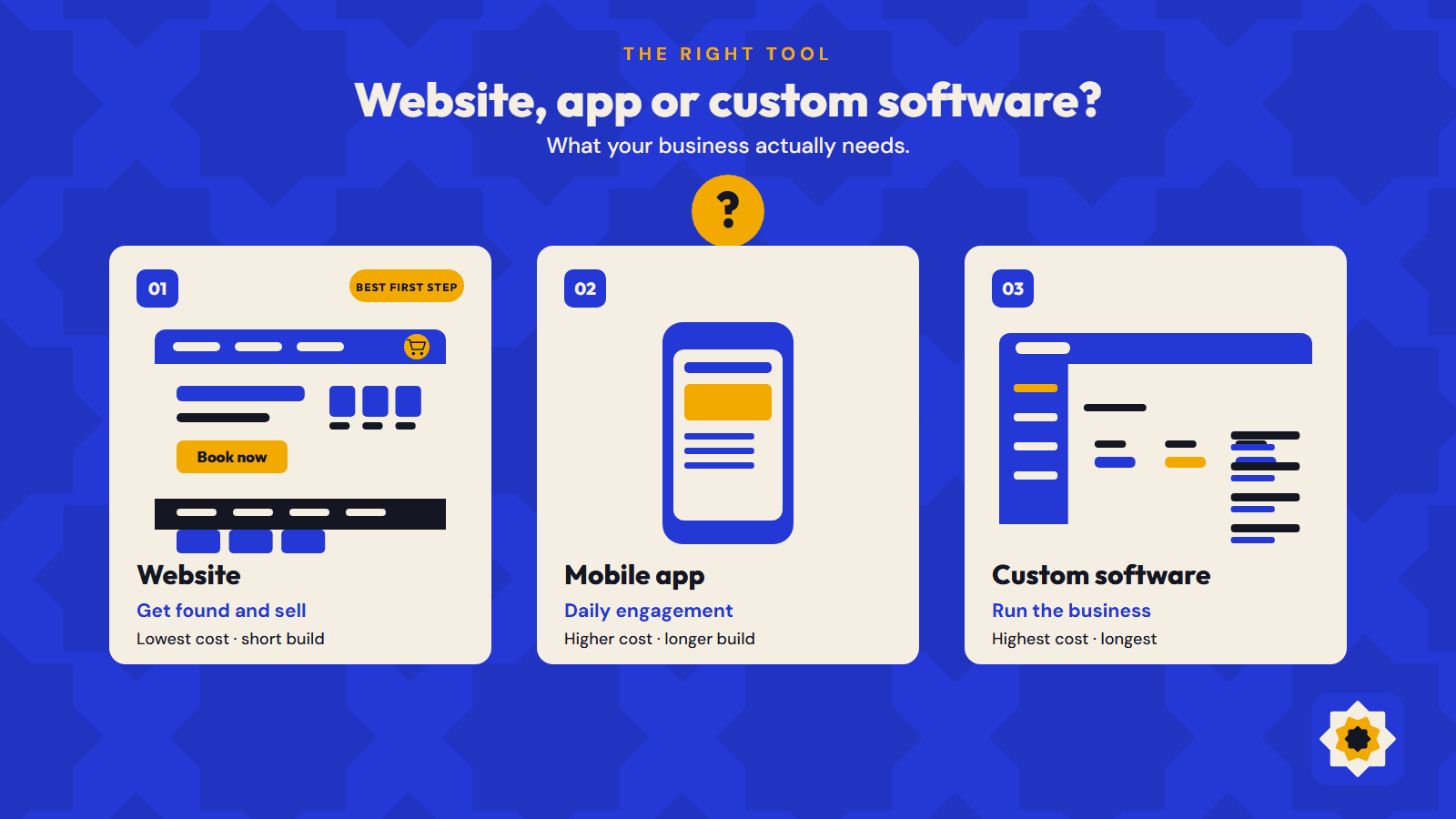
Every week, a business owner asks us for an app. Sometimes they need an app. Often they need a website that works properly, or a simple internal tool that replaces a spreadsheet. The three are not status levels. They are different tools for different jobs.
A website, a mobile app and custom software solve different problems. Choosing the wrong one is expensive not because the technology is bad, but because you pay for a solution to a problem you do not have yet.
Start with the job, not the technology
Before comparing prices, finish this sentence: “We need this because our customers or our staff need to…” The answer is the job. The technology is only the tool.
Most projects fall into one of four jobs:
- Be found and trusted: show services, proof, location and contact details.
- Sell or book: take orders, payments, reservations or quote requests.
- Serve repeat customers: accounts, history, notifications, loyalty or content.
- Run operations: replace spreadsheets, connect tools, manage stock, staff or data.
| Job | Usually start with | Why |
|---|---|---|
| Be found on Google and look credible | Website | Search, pages, speed and no install friction |
| Sell products or take bookings | Website with store or booking | One link works on every device |
| Serve repeat customers with notifications and device features | Mobile app | Home-screen presence, push and offline access |
| Run internal operations and replace spreadsheets | Custom software | Workflow, roles, integrations and data ownership |
Sometimes the answer is a website now and an app later. Sometimes it is custom software behind a website. The sequence matters more than the label.
A website is usually the first useful step
A website is the only option that works for a stranger who has never heard of you. They click a link, land on a page, and can buy or contact you without installing anything. It is also the cheapest to iterate, the easiest to update and the best long-term search asset.
A modern website can take payments, bookings, catalogs, quote requests, customer accounts, dashboards and integrations. Many businesses that think they need an app actually need a better website with a login area.

What a website is not: a native app. It cannot send push notifications as reliably, work fully offline, or access every device feature. For most first-year businesses, that is fine. The customer cares about finding you and finishing the job, not about the technology behind it.
A website is not a PDF
A website is a sales and service system, not a brochure. If it only says who you are, add the jobs customers came to do: buy, book, compare, contact and find you. A beautiful page that answers nothing is still a dead end.
When a mobile app makes sense
An app makes sense when the relationship is repeat and frequent, and the phone itself is part of the value. Think loyalty, repeat ordering, a content community, field staff, scanning, photos, GPS, offline work or push notifications.
It does not make sense as a first version for a business with no audience, no repeat habit and no plan to maintain two codebases and app-store releases. Every download is a barrier. A website link is not.
The first release is not the expensive part; the next three years are. Budget for design, development, backend, store accounts, review, updates, push notifications, analytics, support and the next version. An app is a product you have to feed every month.
An app is not a website in a box. It is a product you have to feed every month.
When custom software is the right answer
Custom software is for work that is specific to your business and not available off the shelf: an operations dashboard, a booking engine with complex rules, inventory across locations, a CRM, quoting, field service, or a workflow that connects several tools. It is usually internal, but it can sit behind a website or an app.
Signs you may need it:
- Spreadsheets are the source of truth, and only one person knows how they work.
- Staff copy data between tools, and the same order is entered three times.
- You pay for five SaaS tools that do not talk to each other.
- Your process is a competitive advantage and off-the-shelf software forces you to work in a bad way.
Signs you probably do not:
- You just need a contact form or a nicer way to present services.
- The process is not documented yet. Software will make a messy process faster, not better.
- You are buying custom because it sounds more serious. The label is not the value.

Custom software is a product, not a one-off project. It needs an owner, training, support and iteration. If nobody inside the business can own it after launch, it will become an expensive museum piece.
The decision in six questions
- Who is the user? A new customer, an existing customer, or your team? New customers usually start with a website.
- How often will they use it? Once a month or every day? Frequency is what justifies an app.
- Does it need the device? Push, camera, GPS, offline or background access? If not, the web is usually enough.
- Is it customer-facing or internal? Internal operations point to custom software, even if it has a web interface.
- What can you maintain? Content, updates, support, app releases and a product owner.
- What is the smallest version? A landing page, a booking page, a single dashboard or a manual process with a better form.
Write the answers down. By question four, the answer is usually obvious. If it is still not obvious, the project is probably too big for a first version.
The usual path: website, then accounts, then app, then custom
For most small businesses in Morocco, the sensible path is: a fast website with a clear offer, WhatsApp and phone contact, and a simple checkout or booking flow. Add customer accounts when people come back. Add an app only when repeat usage is proven. Add custom software when operations become the bottleneck.

Skipping steps is possible, but you pay for it. The businesses that skip usually come back to fix the foundation after spending more than the foundation would have cost.
What it costs and how long it takes
The ranges below are planning ranges, not quotes. They depend on pages, languages, integrations, content and who does the work. For the full breakdown, read our 2027 website and app price guide.
| Option | Typical range | Typical timeline | Best for |
|---|---|---|---|
| Business website | 5,000 – 12,000 MAD | 3 – 5 weeks | Being found, credibility and contact |
| Online store | 8,000 – 25,000 MAD | 4 – 8 weeks | Selling products with COD and card |
| Mobile app | 15,000 – 60,000 MAD | 8 – 16+ weeks | Repeat usage, notifications and device features |
| Custom software | 30,000 MAD and up | 10 – 20+ weeks | Operations, integrations and complex rules |
A cheap app that nobody installs is more expensive than a good website that sells every day. Measure the job, not the download count.
Common expensive mistakes
- Building an app before proving repeat demand. You pay for install friction before you have a habit.
- Choosing custom software before documenting the process. You automate confusion.
- Copying a competitor's stack instead of your customer's job.
- Forgetting content, maintenance and support. The launch is the beginning, not the end.
- Treating the website as a one-time project. A site that is not updated slowly stops working.
- Measuring downloads, likes or page views instead of orders, bookings, leads or saved hours.
The right question is not “What should we build?” It is “What is the smallest thing that removes the bottleneck?” Start there.
Final word
A website, an app and custom software are not medals. They are tools. Start with the job, choose the smallest tool that does it, and earn the right to build the next one.
If you are launching a store, read How to Sell Online in Morocco. If you want to see how we work, read our process from idea to launch. If your current site is losing customers, read 5 Website Mistakes.
Not sure whether you need a website, an app or custom software? Tell us what the business needs to do, and we will recommend the smallest useful first step — even if it is not the biggest project. Contact us.