
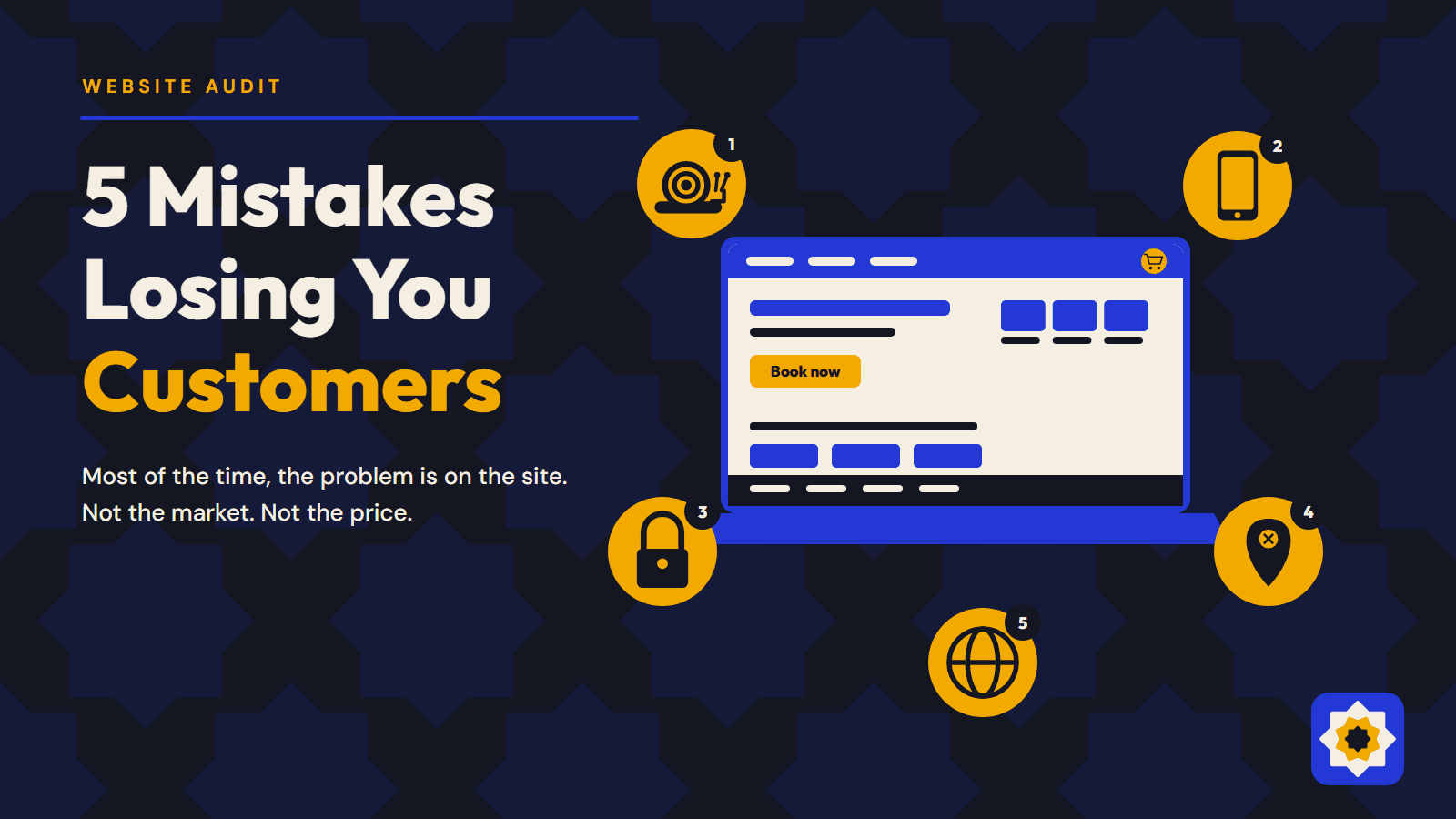
A website can lose customers without ever showing an error. No alarm, no crash. Just a visitor who waits, gets confused, or quietly closes the tab.
After reviewing dozens of Moroccan business websites, the same five mistakes show up again and again. Each one is fixable, and most fixes cost less than the customers they are losing.
1. The site is too slow
A page that takes more than three seconds on mobile is not a minor annoyance. The customer has already decided you are not serious, or they have moved on. Speed is the first trust signal, because it is the first thing they experience.
Common causes: uncompressed images, cheap shared hosting, too many plugins and scripts, no caching, huge fonts, and videos that autoplay. The cost is mobile bounce, lower Google rankings and abandoned checkout.
Fix the biggest weight first. Compress images to WebP or AVIF, lazy-load below the fold, limit fonts and scripts, add caching, use hosting that can handle your traffic, and measure with PageSpeed Insights on mobile. Test on a real phone on 4G, not on your office Wi-Fi.

The three-second test
Open your site on your phone, on mobile data, and count. If the main content is not readable in three seconds, fix speed before adding another feature. A new animation will not rescue a page nobody waits for.
2. It was designed for a desktop, not a phone
Most Moroccan traffic is mobile. If your site has tiny text, horizontal scroll, pop-ups that cover the screen, or buttons too close together, customers leave. A responsive site is not a shrunken desktop site; it is a different layout.
Design at 360 pixels first: one column, larger type, thumb-sized buttons, shorter forms, images that fit, and no hover-only menus. Test on a mid-range Android, not only on the newest iPhone. Make phone and WhatsApp buttons tappable, and check the Arabic and French versions separately.
The most important test: can a customer order or contact you with one thumb? If the answer is no, the desktop version does not matter.
Your customer is not sitting at a desk. They are on a bus, in a shop, or in bed with one hand holding the phone.
3. Customers cannot find you on Google
A beautiful site with no local SEO is a shop in a street with no sign. When someone searches “plumber Casablanca” or “dentist near me”, Google needs to understand what you do, where you do it, and whether you are trustworthy.
Start with a complete Google Business Profile: address, hours, phone, photos, services and reviews. Then make the website match: page titles with service and city, one page per service or city where it makes sense, local business schema, and the same name, address and phone everywhere.
Do not stuff keywords. Answer the question the customer is searching. If you serve Casablanca and Rabat, do not hide both behind one generic page; give each city a real page with real proof. And put your phone, WhatsApp, address and hours where people can see them, not only in the footer.

4. There are too many things to click
A visitor lands on the page. They see “Call us”, “WhatsApp”, “Instagram”, “Facebook”, “Email”, “Book a call”, a newsletter pop-up and a chat bubble. They do nothing. Every additional action competes with the one you actually want.
Choose one primary action per page. On a service page it might be “Request a quote”. On a product page it is “Add to cart”. On a local page it is “Call now”. Repeat it at natural points, and style the secondary actions quietly.
On mobile, a sticky bar with call and WhatsApp can work if those are the main actions. Keep forms short. Do not show a pop-up on first load. After a form is submitted, say exactly what happens next and how fast you reply.

A WhatsApp button is not a strategy. If you use it, set a response time, use a business account, and route complex requests to a form or a call.
5. There is no reason to trust you
Trust is not a badge you add at the end. It is the accumulation of small signals: a real address, a real phone number, real photos, a team, reviews, clear prices, delivery and return policies, privacy, and a site that works. For cash on delivery, trust matters even more: the customer is about to give a stranger their address and then pay cash at the door.
Show the business identity:
- Who you are: a photo of the team, the workshop, the store or the founder.
- Where you are: an address, a map and hours that match Google.
- What people say: named reviews, client quotes or case studies.
- What they get: delivery time, return policy, guarantee and clear pricing.
- How to reach you: phone, WhatsApp and email, with a real response time.
Do not hide the price if you can show a starting price. “Contact us for price” feels like a trap to many buyers. If you are new, borrow trust: partner logos, certifications, real client quotes, a clear process and a guarantee you can keep.
Trust is also consistency. The phone number on the site, Google and Instagram should match. The delivery time on the product page should match the courier. The return policy should match what happens when a customer asks.
The 20-minute audit
Open your site on your phone and do five things. Write down what fails; do not try to fix everything at once.
- Load the homepage on mobile data and count to three. Is the main content readable?
- Try to contact you or order with one thumb. How many taps does it take?
- Search your business plus your city on Google. Can you find it? Is the information correct?
- Count the competing actions on the homepage. Is there one obvious next step?
- Look for an address, phone, reviews, delivery time and return policy. Would you trust this shop with your address and cash?

| Mistake | What the customer feels | First fix |
|---|---|---|
| Slow site | “This is painful; I'll try somewhere else.” | Compress images and fix hosting |
| Desktop-only layout | “I can't read or tap anything.” | Design at 360px and test on Android |
| Invisible on Google | “I couldn't find them.” | Complete Google Business Profile and local pages |
| Too many actions | “What am I supposed to do?” | One primary CTA per page |
| No trust signals | “Is this business real?” | Show address, team, reviews and policies |
Fix the first three. You do not need a full redesign to win back customers; you need to remove the friction that makes them leave.
Most websites do not lose customers in one dramatic moment. They lose them in small delays, dead ends and doubts.
Final word
A website is not a one-time decoration. It is a salesperson that works 24/7. Give it speed, clarity, findability and trust, and it will do the job you hired it for.
If you are deciding what to build, read Website vs. Mobile App vs. Custom Software. If you are launching a store, read How to Sell Online in Morocco. If you want to know what a good site costs, see the 2027 price guide. If you want to see how we work, read our process from idea to launch.
Send us your URL. We will reply with the three fixes that will make the biggest difference, in plain language. No jargon, no obligation. Contact us.